


More often, cargo is opened during transit, inspection or temporary storage and then closed again before reaching its destination.
Without a tamper-evident seal, there is often no reliable way to determine when access occurred or where responsibility changed.
Metal Head Adjustable Cable Seals are designed to provide visible evidence whenever the chain of custody has been interrupted.
By combining a solid aluminum locking body with a galvanized steel cable, they offer greater resistance to pulling, impact and rough handling than standard plastic cable seals while maintaining the flexibility required for containers, trailers, valves and industrial equipment.
They are widely used in container transport, tanker fleets, railway freight, bonded cargo and customs-controlled logistics operations.
Technical Specifications and Selection Guide
Standard cable lengths include 250 mm and 300 mm. Custom lengths are available for OEM projects and industry-specific applications.
|
Cable Diameter |
Typical Breaking Strength* |
Typical Applications |
|
1.8 mm |
≥250 kgf |
Utility equipment, warehouse cages, airline carts |
|
2.5 mm |
≥450 kgf |
Truck trailers, rail freight, cargo vehicles |
|
3.5 mm |
≥1000 kgf |
Export cargo, tankers, bonded transport |
|
5.0 mm |
≥1500 kgf |
Ocean containers, customs-controlled shipments |
Key Advantages
Aluminum Lock Body Resists Impact and Deformation
Compared with polymer housings, aluminum provides:
Higher resistance to impact during loading and unloading;
Improved compression resistance under stacked cargo;
Better dimensional stability during temperature fluctuations;
Lower risk of cracking in cold environments.
Visible damage to the metal housing also makes drilling, crushing or cutting attempts easier to identify during inspection.
One-Way Locking Mechanism Prevents Reuse
Once inserted and tightened, the cable can continue moving forward but cannot move backward without destroying the locking components.
This prevents the seal from being opened and reused after access has occurred.
For logistics providers and customs-controlled cargo, the intact seal becomes a simple visual confirmation that the shipment has remained unopened throughout transport.
Non-Preformed Cable Improves Tamper Visibility
Our metal head cable seals use non-preformed galvanized aircraft cable rather than preformed cable constructions.
When cut, the individual wire strands immediately separate and flare outward instead of remaining tightly bundled together.
This makes reinsertion attempts highly visible and significantly reduces the possibility of resealing the original lock body without leaving evidence of interference.
The result is faster visual inspection and easier identification of unauthorized access.
Adjustable Design Reduces Inventory Complexity
An adjustable cable seal allows a single product platform to accommodate a wide range of locking points and loop sizes.
The cable is simply threaded through the securing points and tightened to the required length.
This flexibility reduces inventory complexity for wholesalers and simplifies purchasing for end users operating multiple transport systems.
Marking and Traceability
Each seal can be permanently laser marked with:
Consecutive serial numbers;
Company logos;
Barcodes;
QR codes;
Customer-specific numbering formats.
Unlike ink printing, laser engraving permanently changes the surface of the aluminum body and remains legible after exposure to moisture, ultraviolet light and handling abrasion.
Compliance and Documentation Support
Metal head cable seals are widely used in international freight operations and customs-supervised cargo movements.
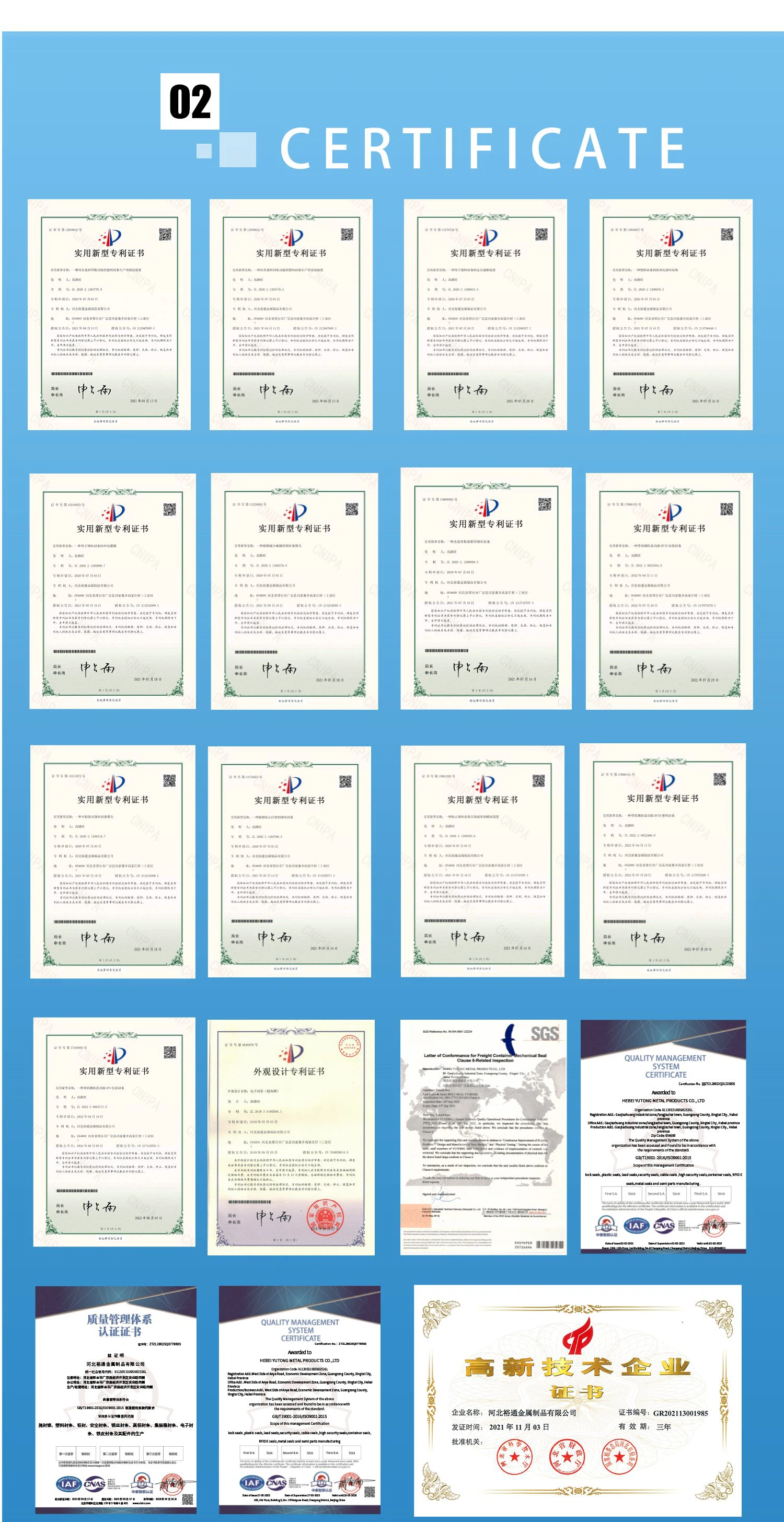
Selected models are available in configurations designed to meet ISO 17712 requirements for high-security seals where certification is required.
These seals are commonly used in support of:
Container export operations;
Customs bonded transportation;
C-TPAT supply chain programs;
AEO authorized operator programs;
Cross-border freight movements.
Documentation available upon request may include:
ISO certificates;
Tensile testing reports;
Material declarations;
Packing specifications;
Country of origin documents.
Production Controls for Wholesale Supply
For distributors and importers, consistency across large production batches is often more important than achieving the lowest purchase price.
Production records can be linked back to individual manufacturing batches when traceability is required.
Common market issues include:
Duplicated serial numbers;
Inconsistent cable diameters;
Weak laser markings;
Unstable locking performance;
Mixed production batches.
To reduce these risks, our production process includes:
Serialization management;
Cable diameter inspections;
Tensile testing;
Marking verification;
Dimensional checks;
outgoing batch inspections.
OEM and Private Label Services
Many distributors prefer to sell under their own brand rather than promote factory branding. We support OEM and private label programs including:
Custom projects can be developed according to regional market requirements and customer branding strategies.
- Custom body colors
- Company logos
- Sequential numbering formats
- Barcode integration
- QR code marking
- Custom packaging
- Multilingual labels
- Neutral export cartons
Typical Applications
Metal Head Adjustable Cable Seals are commonly used for:
Shipping containers
Truck trailers
Railway freight
Fuel tankers
Chemical tankers
Bonded warehouses
Cargo cages
Industrial valves
Export shipments
Customs-controlled logistics
Certificate
FAQ
Hot Tags: metal head adjustable cable seals, China metal head adjustable cable seals manufacturers, suppliers, factory, Anti Tamper Meter Seal, cable seal, Container Steel Cable Security Seals, door latch tools, Stainless Steel Wire Seals, Traceable Trailer Seal


